AI Is Now at the Center of Modern Warfare
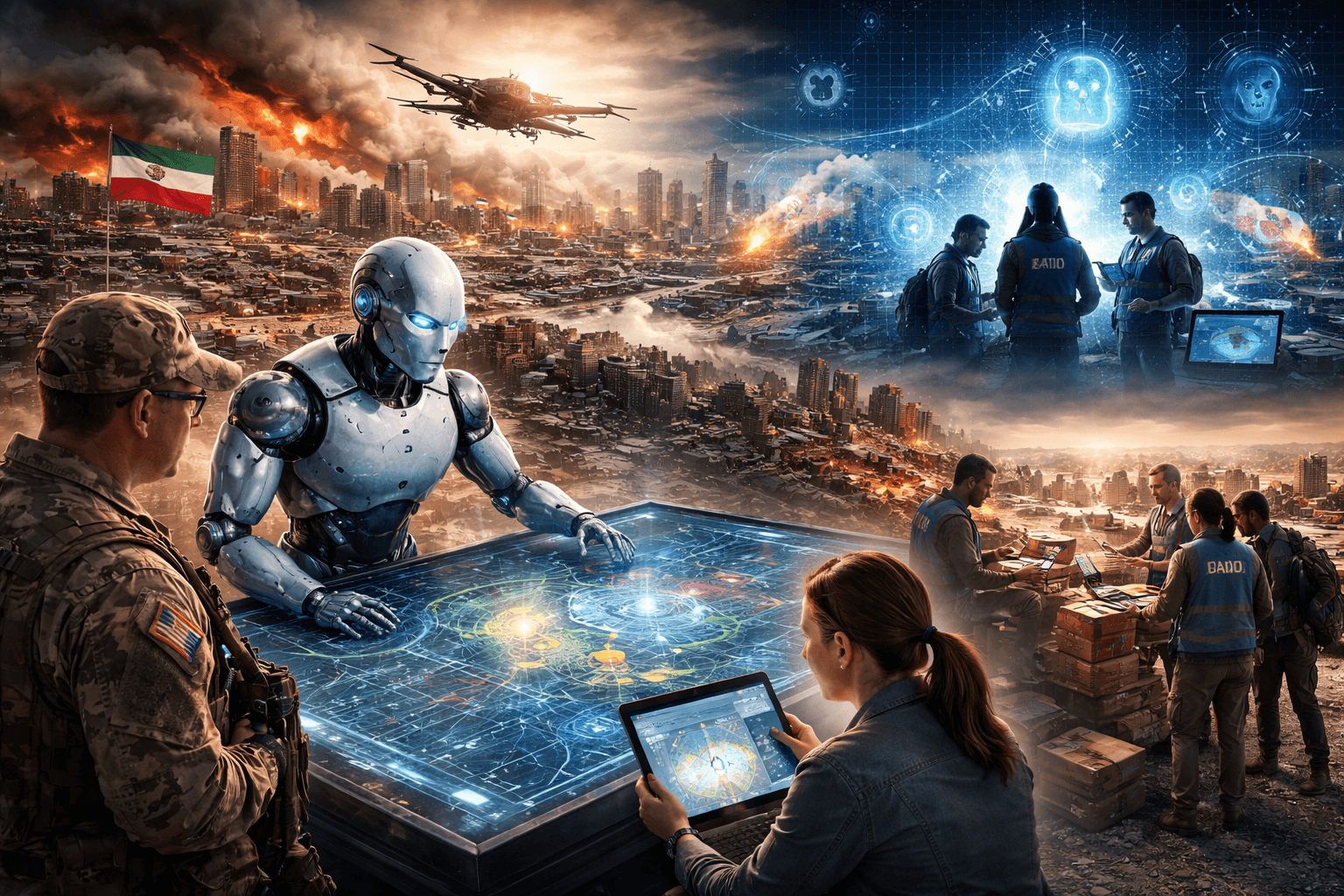
The U.S.–Iran conflict marks one of the first large-scale deployments of AI directly in military operations. AI is no longer limited to analysis—it is actively influencing decisions on the battlefield.
AI systems are being used for target identification, intelligence processing, and real-time decision-making
Military operations are increasingly happening at machine speed, compressing timelines from hours to seconds
Automated systems have reportedly supported thousands of strike decisions, reducing human intervention
This represents a turning point: wars are no longer purely human-led—they are now human–machine collaborations.
The Expansion of AI Beyond the Battlefield
What makes this conflict unique is that AI is influencing multiple domains simultaneously:
1. Cyber Warfare and Digital Threats
AI is fueling a surge in cyberattacks, misinformation, and digital espionage.
Nation-state actors are deploying AI-driven cyber tools and deepfakes
Information warfare is blurring reality, making it harder to distinguish truth from propaganda
Public perception is increasingly shaped by AI-generated narratives
2. Infrastructure and Data Vulnerability
AI relies heavily on infrastructure—and that infrastructure is now a target.
Data centers powering cloud and AI systems have already been struck in the region
Disruption of these systems affects banks, communications, logistics, and AI platforms globally
This highlights a new reality: AI infrastructure is now strategic infrastructure.
3. Economic Shockwaves
The war is disrupting energy markets and global trade, which directly impacts AI growth.
Oil supply disruptions and rising prices are destabilizing economies
AI companies dependent on global supply chains, compute resources, and investment are facing uncertainty
AI is both a driver of efficiency and a victim of geopolitical instability.
The Risks: Acceleration Without Control
The rapid militarization of AI introduces serious concerns:
Reduced human oversight in life-and-death decisions
Ethical ambiguity around autonomous or semi-autonomous weapons
Escalation risks, where faster decision cycles increase the chance of unintended conflict
Global discussions are already underway to regulate AI in warfare, emphasizing the urgency of governance .
How AI Could Be Used for the Advantage of All
Despite the risks, this moment also presents an opportunity. AI does not have to be purely destructive—it can be redirected toward stabilization, protection, and global cooperation.
1. Conflict De-escalation and Diplomacy
AI can analyze vast geopolitical data to:
Predict escalation patterns
Suggest diplomatic interventions
Simulate outcomes of peace agreements
Used correctly, AI could become a decision-support system for peace, not just war.
2. Humanitarian Aid and Crisis Response
AI can significantly improve how the world responds to war:
Real-time mapping of civilian risk zones
Optimizing aid delivery routes
Monitoring refugee movements and needs
This shifts AI from offense to human protection and logistics.
3. Cyber Defense and Global Security
Instead of escalating cyber warfare, AI can strengthen defense:
Detecting and neutralizing cyberattacks before they spread
Identifying misinformation and deepfake campaigns
Protecting financial and communication systems
AI could serve as a global digital immune system.
4. Economic Stabilization
AI can help governments and organizations respond to economic shocks:
Predicting supply chain disruptions
Optimizing energy distribution
Supporting financial systems under stress
In a conflict disrupting oil and trade, AI becomes a tool for resilience.
5. Ethical Frameworks and Global Cooperation
This war may accelerate international agreements on AI use:
Establishing limits on autonomous weapons
Creating shared standards for AI deployment
Promoting transparency between nations
In this sense, conflict could paradoxically lead to stronger global AI governance.
A Defining Moment for AI
The U.S.–Iran conflict is more than a regional war—it is a global test of how humanity uses artificial intelligence. It exposes both extremes:
AI as a tool for efficiency, precision, and dominance
AI as a potential force for stability, protection, and cooperation
The direction AI takes will depend not on the technology itself, but on human intent and governance.
Conclusion
In the short term, the war is accelerating AI’s role in warfare, cybersecurity, and global economics. But in the long term, it is forcing a deeper question: What is AI ultimately for?
If guided responsibly, AI could emerge from this conflict not just as a weapon—but as a bridge toward smarter, safer, and more coordinated global systems.
The real battle is no longer just on the ground—it is in how we choose to design, deploy, and control intelligence itself.